
On this page
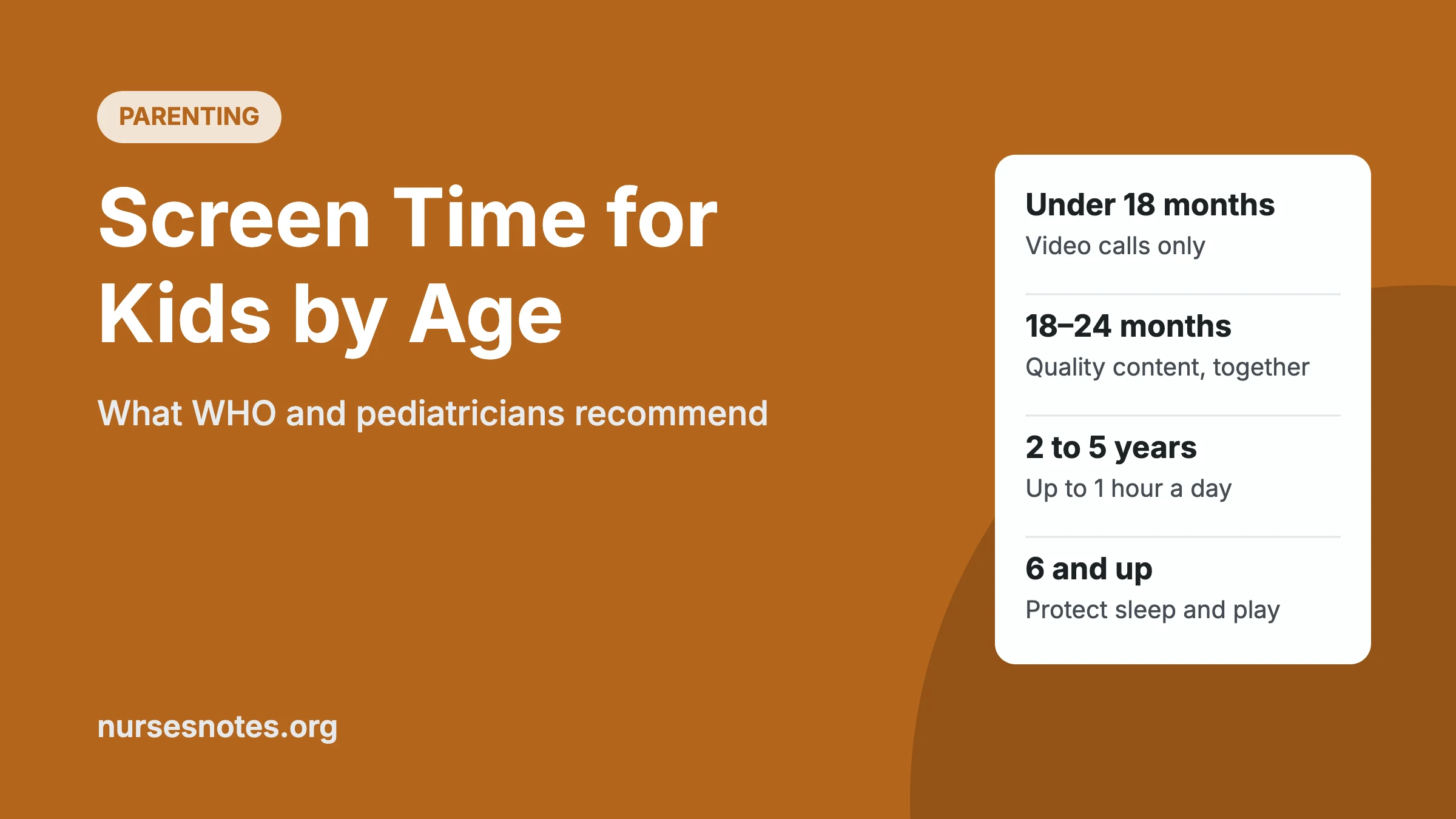
Screen time for kids should be as close to zero as possible before 18 months to 2 years, and no more than 1 hour a day of good-quality content for children aged 2 to 5, according to the World Health Organization (WHO) and the American Academy of Pediatrics (AAP). From school age, the focus shifts from a fixed number of hours to making sure screens do not crowd out sleep, play, and family time.
Key points
- Under 1 year: no screen time, says the WHO. Video calls with family are the one exception the AAP allows before 18 months.
- 18 to 24 months: if you introduce media, choose high-quality content and watch it together.
- 2 to 5 years: no more than 1 hour a day of high-quality programmes, ideally watched with an adult. Less is better.
- 6 years and up: set consistent limits and protect sleep, physical activity, and homework time.
Recommended screen time by age
The WHO guideline covers children under 5, and the AAP adds advice for older children. The table puts both side by side.
| Age | WHO guidance | AAP guidance |
|---|---|---|
| Under 1 year | Screen time not recommended | Avoid screens except video chatting (until 18 months) |
| 1 year | Sedentary screen time not recommended | Avoid screens except video chatting until 18 months; from 18 months, only high-quality content watched together |
| 2 years | No more than 1 hour a day; less is better | Up to 1 hour a day of high-quality programmes, watched together |
| 3 to 4 years | No more than 1 hour a day; less is better | Up to 1 hour a day of high-quality programmes, watched together |
| 5 years and older | Not covered by the under-5 guideline | Consistent limits that leave time for sleep, activity, and family |
Why screen time limits matter for young children
Babies and toddlers learn language and social skills from back-and-forth with real people, such as talking, reading, singing, and playing. AAP experts note that children under 18 months get very little from watching screens, and that every hour on a device is an hour not spent interacting.
The WHO guideline also links screen habits to the rest of the day. Young children need active play and enough sleep, and long periods strapped into a seat or sitting in front of a screen take time away from both. Screens close to bedtime can also make it harder for children to fall asleep.
How much sleep and activity young children need
The same WHO guideline sets daily targets for movement and sleep, which helps when planning a screen-light routine.
- Infants under 1 year: active several times a day, including at least 30 minutes of tummy time spread through the day for babies who are not yet mobile, and 12 to 16 hours of sleep (14 to 17 hours for babies 0 to 3 months).
- Toddlers 1 to 2 years: at least 180 minutes of physical activity a day and 11 to 14 hours of good-quality sleep, including naps.
- Children 3 to 4 years: at least 180 minutes of activity, with at least 60 minutes of energetic play, and 10 to 13 hours of sleep.
Practical tips to cut down screen time
- Watch together. Talk about what you see and link it to real life, such as counting objects or naming colours.
- Pick quality over quantity. Choose slow-paced, age-appropriate programmes made for young children, not fast cartoons or endless autoplay.
- Make screen-free zones. Keep meals, bedrooms, and the hour before bed screen-free.
- Turn off background TV. A TV left on while children play can distract them and cut down conversation.
- Do not use screens to calm every tantrum. The AAP warns that relying on screens to soothe can make it harder for children to learn to calm themselves.
- Model the habit. Children copy what adults do, so put your own phone away during family time.
- Make a family media plan. Agree on rules for when, where, and what, and stick to them.
When to talk to a doctor
Talk to your child’s doctor or nurse if your child gets very upset when screens are taken away, screen use is affecting sleep or eating, or you notice delays in speech, play, or social skills. Many children with delays catch up well with early support, so it is worth asking early.
Frequently asked questions
Is video calling with grandparents counted as screen time?
The AAP makes an exception for video chatting, even for babies under 18 months, because it involves live, back-and-forth interaction with a familiar person. The WHO limits refer to sedentary screen time such as watching TV or videos and playing games.
Are educational apps okay for toddlers?
Many apps call themselves educational without evidence. If you use media with a child aged 18 months to 5 years, choose high-quality content, keep it short, and use it together so your child can connect what they see to real life.
How much screen time is too much for a 6-year-old?
There is no single number for school-age children. The AAP advises consistent limits that protect sleep, at least an hour of daily physical activity, homework, and family time, plus no screens in the hour before bed.
Related on Nurses Notes
Sources
- To grow up healthy, children need to sit less and play more. World Health Organization (24 April 2019).
- American Academy of Pediatrics announces new recommendations for children’s media use. ScienceDaily, from AAP materials (October 2016).
- New AAP screen time recommendations. Seattle Children’s (interview with Dr Dimitri Christakis, author of the AAP policy for ages 18 months to 5 years).
- Screen-time recommendations for children under six. ZERO TO THREE.
This article is for education only and does not replace advice from your child’s doctor, nurse, or other qualified health professional.