
On this page
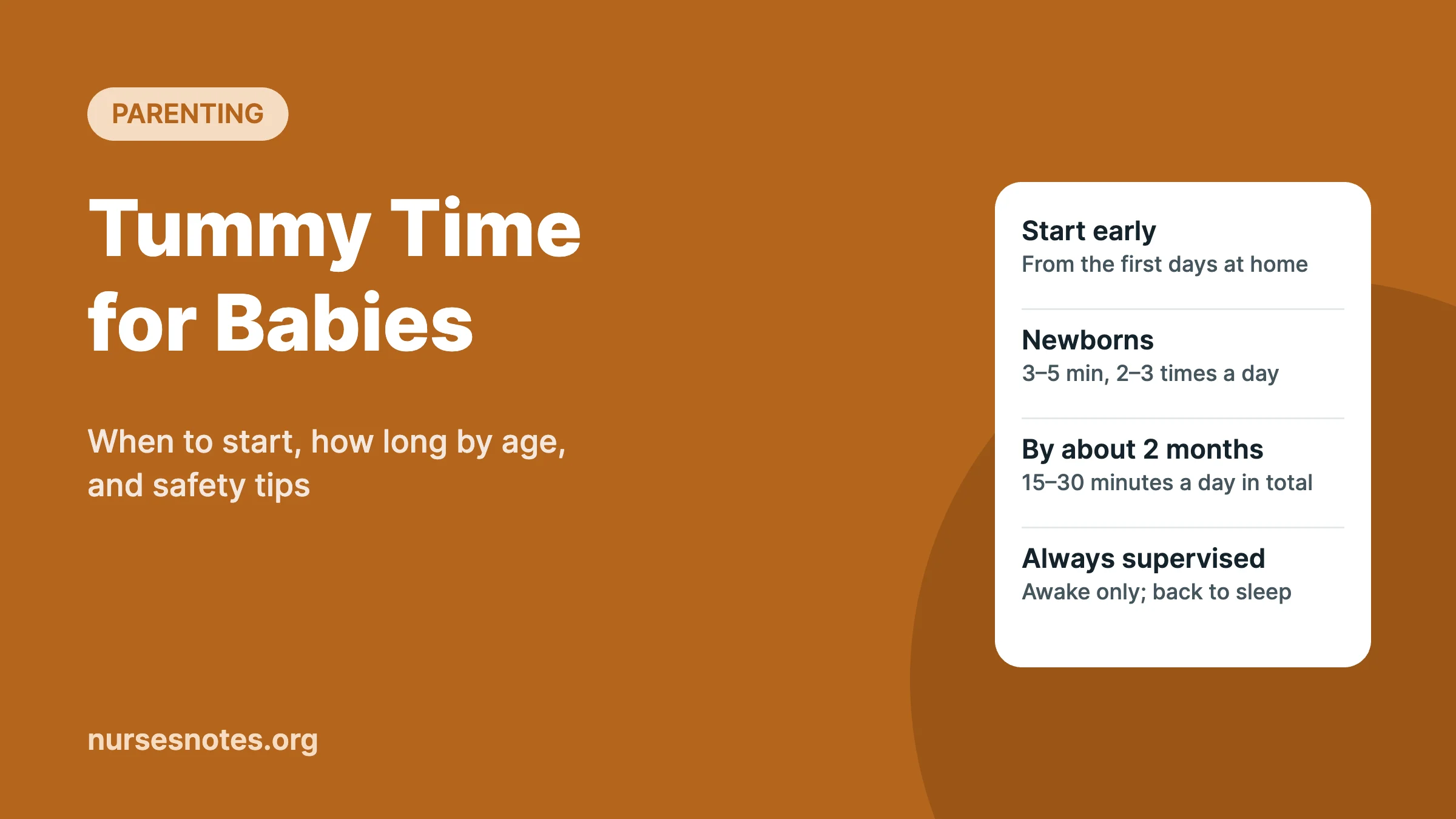
Tummy time is supervised play on your baby’s stomach while they are awake, and you can start it from the first days at home. Begin with 2 to 3 short sessions of 3 to 5 minutes a day, then slowly build up to a total of 15 to 30 minutes a day by about 7 weeks to 2 months.
Key points
- Tummy time is only for when your baby is awake and someone is watching closely; never let your baby sleep on their tummy.
- “Back to sleep, tummy to play”: place your baby on their back for every sleep, including naps.
- Tummy time strengthens the neck, shoulders, and arms for rolling, sitting, and crawling, and helps prevent flat spots on the head.
- Short, frequent sessions work best; if your baby gets upset, stop and try again later.
Why is tummy time important?
Babies should always sleep on their backs, so they spend a lot of time lying that way. Awake time on the tummy balances this out. The NICHD Safe to Sleep campaign notes that tummy time does not directly lower the risk of SIDS, but it:
- Strengthens neck, shoulder, and arm muscles so your baby can sit, crawl, and later walk
- Helps develop motor skills
- Helps prevent flat spots on the back of the head
The American Academy of Pediatrics (AAP) adds that tummy time prepares babies to slide on their bellies and, later, to crawl.
When to start tummy time
The AAP suggests starting the day your baby comes home from the hospital, even before the umbilical cord stump falls off. NICHD says most babies can start a day or two after birth.
If your baby was born early, has reflux, or has a physical disability, Cleveland Clinic advises talking to your pediatrician before you begin.
How long should tummy time be by age?
| Age | How much tummy time |
|---|---|
| Newborn (first weeks) | 2 to 3 sessions a day, 3 to 5 minutes each |
| By 7 weeks to 2 months | Build up to 15 to 30 minutes in total each day |
| By 3 months | Up to about 30 minutes in total a day |
| 4 to 6 months | Keep going; babies begin rolling from tummy to back and back to tummy |
| 6 months until crawling | Cleveland Clinic suggests working up to 60 to 90 minutes a day |
The minutes do not have to come all at once. Several short sessions spread through the day add up.
How to do tummy time step by step
- Pick a good moment when your baby is awake and alert, such as after a diaper change or after a nap.
- Choose a safe spot: a clean blanket on a firm floor. Avoid beds, sofas, or other furniture your baby could fall from, even if they cannot roll yet.
- Place your baby on their tummy with arms forward. For a newborn, a small rolled towel or receiving blanket under the chest and arms gives a little lift.
- Get down to their level. Lie on your tummy facing your baby, and talk, sing, and smile. Babies under 4 months see best at about 12 to 18 inches (30 to 45 cm) away.
- Use toys: put a toy just out of reach, or place toys in a circle around your baby so they turn and reach.
- Watch the whole time. If your baby gets fussy, pick them up or turn them over, and try again later.
- If your baby falls asleep, gently roll them onto their back and move them to their own safe sleep space.
Other ways to do tummy time
- Tummy to tummy: lie on your back and place your baby on your chest.
- Side-lying play from around 3 to 4 months: support your baby’s back with a rolled blanket, and alternate the right and left sides equally.
- Sibling play: an older child can play with your baby on the floor while an adult watches.
- Upright cuddles: holding your baby upright when awake also takes pressure off the back of the head.
What if my baby hates tummy time?
Many babies dislike it at first. These ideas can help:
- Keep sessions short and frequent; even a minute or two counts.
- Start on your chest, where your baby can see your face. Cleveland Clinic notes that a more upright angle makes lifting the head easier.
- Put your face or a favorite toy within reach.
- Choose times when your baby is rested and content, not hungry or tired.
Most babies start to enjoy tummy time as they get stronger.
How to prevent flat spots on the head
- Give tummy time every day.
- Limit time in bouncers, swings, carriers, and car seats when you are not travelling.
- Hold your baby upright when they are awake.
- Change the direction your baby lies in the crib each week, while always placing them on their back.
- Switch sides during feeds: change breasts if breastfeeding, or the arm you hold your baby in if bottle-feeding.
The AAP notes that a flat spot usually rounds out as babies grow older and start to sit up.
When to talk to your doctor
Talk to your pediatrician or health worker if:
- Your baby cannot turn their head to both sides, or always seems to look one way
- You notice a flat spot that is not improving, or you are worried about the shape of their head
- Your baby does not seem to be reaching movement milestones, such as rolling (see baby milestones by month)
- Your baby was born early, has reflux, or has a physical disability, before you start tummy time
Get emergency help right away by calling your local emergency number if your baby ever has trouble breathing, turns blue or very pale, or becomes floppy or hard to wake.
Frequently asked questions
Can newborns do tummy time?
Yes. The AAP suggests starting tummy time the day your baby comes home from the hospital, even before the umbilical cord stump falls off. Begin with 2 to 3 sessions a day of 3 to 5 minutes each. Lying tummy to tummy on your chest is a gentle way to start with a newborn who is just learning to lift their head.
Can my baby sleep during tummy time?
No. Tummy time is only for when your baby is awake and an adult is watching closely. If your baby falls asleep on their tummy, gently turn them onto their back and move them to a firm, flat sleep surface with no soft bedding. Babies should always be placed on their backs to sleep, including for naps.
Does tummy time on my chest count?
Yes. The AAP lists lying on your back with your baby on your chest as one way to do tummy time. It is a good start for newborns and for babies who dislike the floor. Cleveland Clinic notes that flatter positions work the muscles harder, so add floor time on a blanket as your baby gets stronger.
Related on Nurses Notes
- Baby milestones by month: what to expect
- Safe sleep for babies: how to lower the risk of SIDS
- Umbilical cord care for newborns
- More Parenting articles for families
Sources
- Back to Sleep, Tummy to Play: Give Your Baby a Safe, Strong Start. American Academy of Pediatrics, HealthyChildren.org, updated 2026.
- Tummy Time for a Healthy Baby. Safe to Sleep, Eunice Kennedy Shriver National Institute of Child Health and Human Development (NICHD), accessed November 2026.
- How To Do ‘Tummy Time’ at Every Age. Cleveland Clinic, 2025.
This article is for education only and does not replace advice from your own doctor, nurse, or other qualified health professional.