
On this page
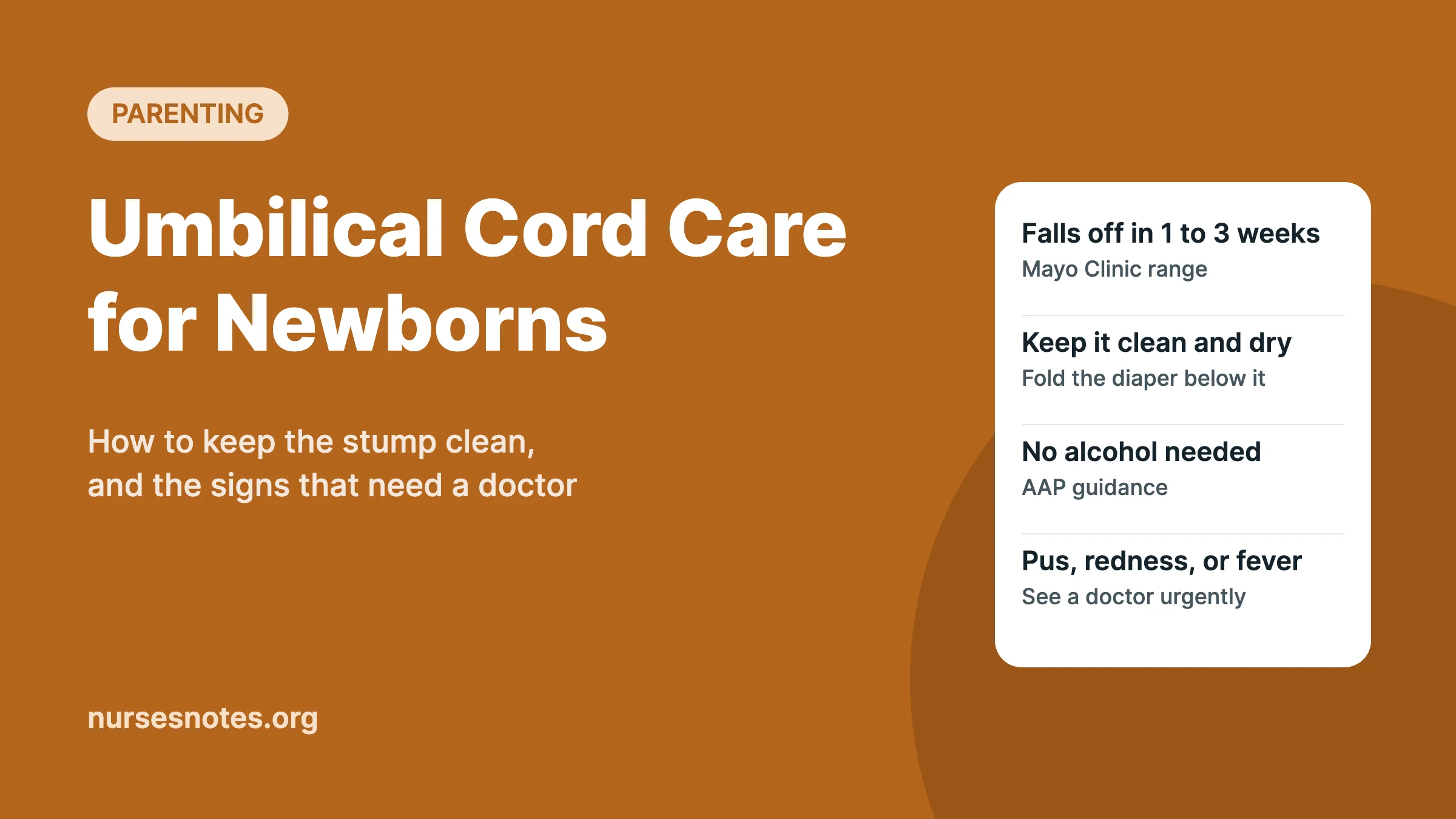
Good umbilical cord care for newborns is simple: keep the stump clean and dry, let air reach it, and wait for it to fall off on its own, usually 1 to 3 weeks after birth. You do not need alcohol or other products, but you do need to know the signs of infection that mean your baby should see a doctor quickly.
Key points
- Most cord stumps dry up and fall off between 5 days and 3 weeks after birth.
- Keep the stump clean and dry, fold the diaper below it, and give sponge baths until it falls off.
- The AAP says there is no need to put alcohol on the stump.
- Pus, spreading redness, a bad smell, fever, poor feeding, or a very sleepy baby need urgent medical care.
What happens to the umbilical cord after birth?
After birth, the cord is clamped and cut, leaving a short stump on your baby’s belly. Cleveland Clinic explains that the stump dries out and changes colour from yellowish-green to brown to black before it drops off.
MedlinePlus says the stump usually falls off when the baby is 5 to 15 days old, and Mayo Clinic gives a range of 1 to 3 weeks. A few drops of blood on the diaper around this time are normal, a bit like a scab coming off.
How to clean the umbilical cord stump
Current AAP and WHO guidance for babies born in hospitals is “dry cord care”. Follow these steps:
- Wash your hands before touching the cord area.
- Keep it dry and open to the air. Fold the top of the diaper down below the stump so it is not covered or rubbed.
- Clean only when it gets dirty. If urine or stool gets on it, gently wipe with clean water (or mild soap and water for stool), then pat dry. MedlinePlus advises using gauze and water only.
- Give sponge baths instead of tub baths until the stump has fallen off.
- Let it fall off naturally. Never pull it, even if it is hanging by a thread.
- Skip the alcohol. The AAP says there is no need to use it, and Cleveland Clinic notes it may slow healing by killing helpful bacteria.
Do not put powders, oils, coins, herbs, or other traditional remedies on the cord or navel. In some settings with high newborn death rates and home births, the WHO recommends chlorhexidine for the cord; use it only if your midwife, nurse, or doctor tells you to.
What is normal and what is not
| What you see | What it usually means |
|---|---|
| Stump turning brown or black and drying | Normal healing |
| A few drops of blood when it falls off | Normal; tell your doctor if bleeding gets worse or continues after 3 days |
| A small pink or red moist lump after it falls off | Possible umbilical granuloma; often harmless, and a doctor can treat it if it lasts more than a week |
| A soft bulge at the navel that pushes out when baby cries | Possible umbilical hernia; usually closes by itself, but have it checked |
| Yellow, smelly discharge, or redness spreading onto the belly | Possible infection (omphalitis); see a doctor urgently |
The AAP warns parents not to tape a coin or anything else onto a bulging navel. Changing diapers often also helps keep the area clean; see our tips on how to treat diaper rash.
Signs of umbilical cord infection
Cord infection is uncommon, but it can become serious quickly in a newborn. Watch for:
- Redness or swelling of the skin around the base of the stump, or red streaks spreading out
- Pus or cloudy, yellow fluid oozing from the stump
- A foul smell
- Your baby crying when you touch the stump or the skin around it
- Warmth around the area (redness can be harder to see on darker skin)
When to get medical help
Get urgent medical care straight away if your baby has any of these:
- A fever of 38°C (100.4°F) or higher
- Poor feeding, or not waking for feeds
- Unusual sleepiness, floppiness, or being hard to wake
- Bleeding from the cord that does not stop, or more blood each time you wipe
- Redness spreading onto the belly, swelling, or pus
Call your baby’s doctor or health centre if the stump has not fallen off by about 3 weeks (some sources say 4 weeks), if a moist lump stays after a week, or if you are worried about how it looks. The NHS advises telling your midwife, health visitor, or GP about any bleeding or discharge. In the Philippines you can also ask your barangay health worker, midwife, or nurse at your health centre to check it during your baby’s newborn visits.
Frequently asked questions
How long does it take for the umbilical cord to fall off?
Most stumps fall off between 5 and 15 days after birth, and Mayo Clinic says 1 to 3 weeks is usual. If it is still attached at about 3 weeks, or shows any signs of infection, contact your baby’s doctor. Never pull it off yourself, even when it seems loose and ready to drop.
Should I clean my baby’s umbilical cord with alcohol?
No, not routinely. The American Academy of Pediatrics says there is no need to use alcohol on the stump, and keeping it clean and dry works well. Wipe it with clean water only if it gets dirty, then pat it dry. Use other products only if your doctor or midwife advises them.
Is it normal for the umbilical cord to bleed or smell?
A few drops of blood when the stump falls off are normal. A foul smell, yellow discharge, or bleeding that keeps coming back is not normal. These can be signs of infection, so have your baby checked promptly.
Related on Nurses Notes
- Newborn jaundice: signs and when to worry
- How much should a newborn eat?
- Safe sleep for babies
- All parenting articles on Nurses Notes
Sources
- Umbilical Cord Care in Newborns. HealthyChildren.org, American Academy of Pediatrics, 2025.
- Umbilical cord care in newborns. MedlinePlus Medical Encyclopedia, U.S. National Library of Medicine, 2025.
- Umbilical cord care: Do’s and don’ts for parents. Mayo Clinic, 2024.
- Umbilical Cord. Cleveland Clinic, 2024.
- Your newborn baby. NHS, 2024.
- WHO Recommendations on Postnatal Care of the Mother and Newborn. World Health Organization, 2013 (via NCBI Bookshelf).
This article is for education only and does not replace advice from your own doctor, nurse, or other qualified health professional.