On this page
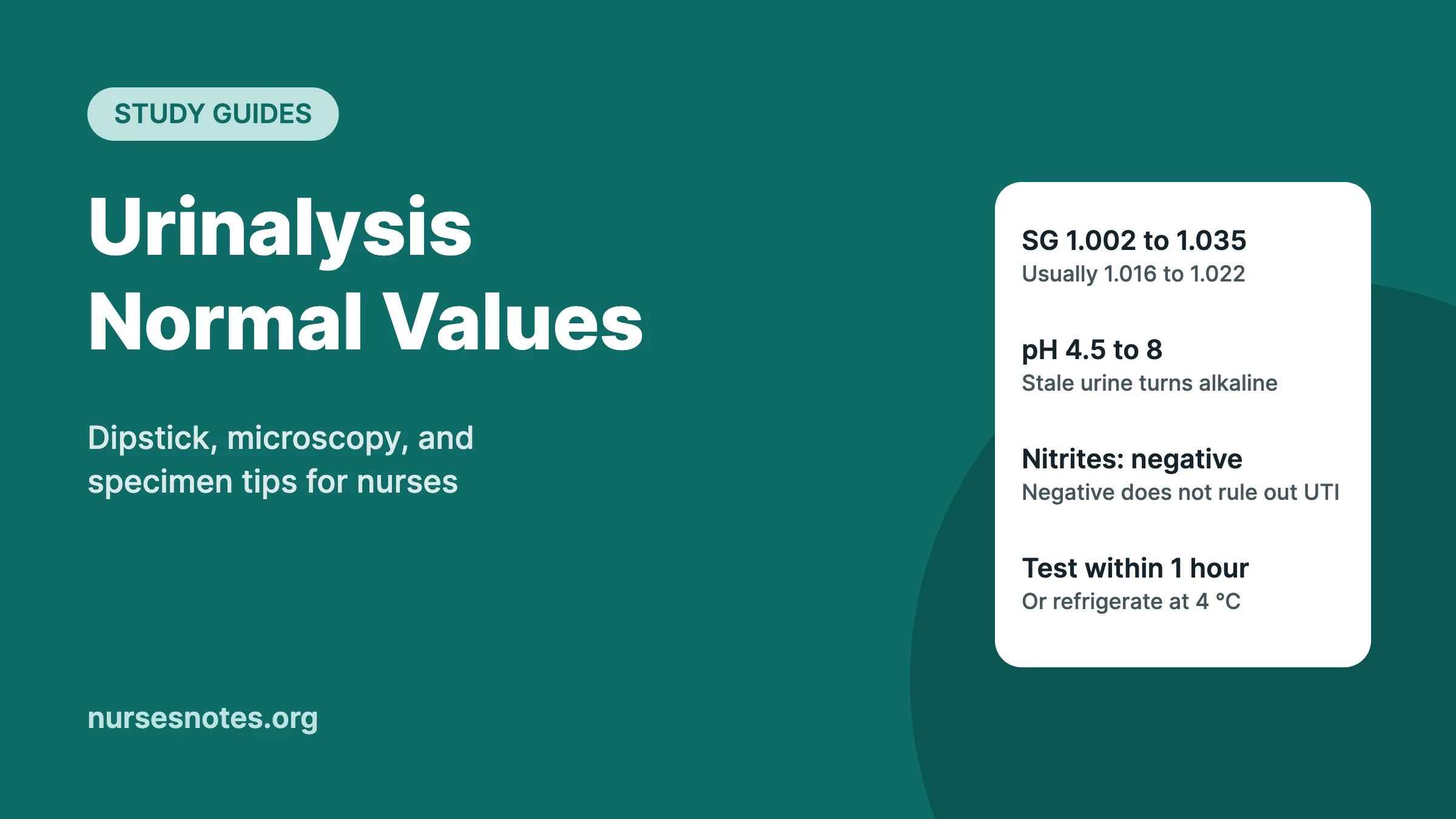
Urinalysis normal values describe what healthy urine looks like on three checks: a visual exam (pale to amber yellow and clear), a dipstick (specific gravity about 1.002 to 1.035, pH about 4.5 to 8, and negative for glucose, ketones, nitrites, and leukocyte esterase), and microscopy (few or no cells, casts, or crystals). This guide puts the ranges in one table, explains what abnormal results may point to, and covers the nursing steps that keep a specimen accurate.
Key points
- A routine urinalysis has three parts: visual, dipstick (chemical), and microscopic exams.
- Typical adult specific gravity is 1.002 to 1.035 and pH is 4.5 to 8, but reference ranges vary by laboratory.
- Glucose, ketones, bilirubin, nitrites, and leukocyte esterase are normally negative.
- A clean-catch midstream sample tested within 1 hour (or refrigerated) gives the most reliable result.
What is a urinalysis?
A urinalysis is a test of a urine sample that helps screen for and monitor problems such as urinary tract infection, kidney disease, poorly controlled diabetes, and kidney stones. It is cheap, quick, and non-invasive, so it is one of the most common tests nurses collect on the ward, in clinics, and in the emergency department.
The test has three parts:
- Visual exam: colour and clarity.
- Dipstick (chemical) exam: a strip with chemical pads that change colour for specific gravity, pH, protein, glucose, ketones, blood, bilirubin, urobilinogen, nitrites, and leukocyte esterase.
- Microscopic exam: spun urine sediment checked for red and white blood cells, epithelial cells, casts, crystals, and organisms.
Urinalysis normal values table
The values below follow the StatPearls urinalysis chapter on NCBI Bookshelf. Other references use slightly different cut-offs (for example, Cleveland Clinic lists pH 5.0 to 8.0 and specific gravity 1.005 to 1.030), so always use your own laboratory’s reference range.
| Parameter | Typical normal finding | Notes |
|---|---|---|
| Colour | Pale yellow to deep amber | Some foods (such as beets) and medicines change colour |
| Clarity | Clear or translucent | Cloudiness may come from cells, bacteria, crystals, or mucus |
| Specific gravity | 1.002 to 1.035 (usually 1.016 to 1.022) | Reflects urine concentration; lab dependent |
| pH | 4.5 to 8 (usually 5.5 to 6.5) | A specimen left standing tends to turn alkaline |
| Protein | Negative on dipstick (up to 150 mg/day in a 24-hour collection) | Trace may be reported by some labs |
| Glucose | Negative | Appears when blood glucose exceeds the kidney threshold |
| Ketones | Negative | Seen in DKA, fasting, or very low-carbohydrate diets |
| Blood (haemoglobin) | Negative | Positive dipstick needs microscopy to confirm red cells |
| Bilirubin | Negative | Not present in normal urine |
| Urobilinogen | 0.1 to 1 mg/dL (random sample) | Small amounts are normal |
| Nitrites | Negative | A negative result does not rule out UTI |
| Leukocyte esterase | Negative | Marker of white cells (pyuria) |
| Red blood cells | 0 to 5 per high-power field | Cleveland Clinic lists 0 to 3/HPF |
| White blood cells | 0 to 5 per high-power field | Higher counts suggest inflammation or infection |
| Squamous epithelial cells | Up to about 15 to 20 per HPF | Many suggest the sample was contaminated |
| Casts | Hyaline casts up to 5 per low-power field; other casts absent | Cellular casts point to kidney disease |
| Crystals, bacteria, and yeast | Absent | Interpret with symptoms and the clinical picture |
What abnormal urinalysis results may mean
A single abnormal value is a clue, not a diagnosis. The doctor interprets results alongside symptoms, history, and other tests such as BUN and creatinine or a urine culture.
- High specific gravity: dehydration, diarrhoea, glucose in the urine, recent contrast dye, or SIADH.
- Low specific gravity: diuretics, diabetes insipidus, or reduced kidney concentrating ability.
- Alkaline pH: a stale specimen (the most common cause), urease-producing bacteria, or renal tubular acidosis.
- Acidic pH: diabetic ketoacidosis, diarrhoea, or a high-protein diet.
- Glucose: diabetes mellitus, pregnancy, or rare kidney tubular disorders.
- Ketones: diabetic ketoacidosis, fasting, or starvation.
- Blood or red cells: kidney stones, infection, glomerulonephritis, trauma, or tumours.
- Nitrites and leukocyte esterase together: strongly suggest a bacterial urinary tract infection.
- Bilirubin: liver disease or blocked bile ducts.
- Protein: possible kidney disease; protein that persists on repeat tests needs follow-up.
Nursing assessment before and after collection
- Ask about symptoms: burning, frequency, urgency, flank pain, fever, or blood in the urine (see UTI symptoms).
- Check medicines, supplements, and foods that colour urine or affect results.
- Note menstruation, recent catheterisation, or recent contrast imaging, and record them on the request.
- Assess hydration, intake and output, and vital signs.
- Observe the sample: colour, clarity, odour, and volume.
How to collect a clean-catch midstream urine sample
- Explain the steps and give the patient a sterile container and cleansing wipes.
- Perform hand hygiene. The patient washes their hands too.
- Clean the urethral area: females separate the labia and wipe front to back; males retract the foreskin (if present) and clean the tip of the penis.
- Void the first part of the stream into the toilet.
- Collect the midstream portion (about 15 to 30 mL, or as your lab requests) without touching the inside of the cup or lid.
- Finish voiding in the toilet, close the lid, and label the container at the bedside.
- Send it to the lab within 1 hour. If there is a delay, refrigerate at 4 °C for up to 24 hours.
For catheterised patients, take the sample from the sampling port with an aseptic technique, never from the drainage bag. Our Foley catheter care guide covers the steps.
Nursing considerations
- A first morning sample is the most concentrated and best for detecting abnormalities.
- Old or warm samples give false results: pH rises, bacteria multiply, and cells and casts break down.
- Many squamous epithelial cells mean contamination. Recollect rather than act on the result.
- Report new glucose or ketones in a diabetic patient promptly, along with blood glucose.
- Report urinalysis findings together with fever, flank pain, confusion, or low urine output, as these may signal a serious infection.
- Follow facility policy for urine culture: it is usually sent from the same clean-catch sample before antibiotics start.
Exam tips
- “Stale urine is alkaline”: if a question describes a sample left at room temperature, expect a falsely high pH and more bacteria.
- Nitrite negative is not UTI negative: some organisms do not make nitrite, and urine needs time in the bladder to convert nitrate.
- Specific gravity tracks fluid status: high in dehydration, low in fluid overload or diabetes insipidus.
- Ketones plus glucose plus acidic urine: think DKA (see our DKA nursing interventions).
- Never sample from the drainage bag. This is a favourite NCLEX distractor.
Frequently asked questions
What is the normal specific gravity of urine?
StatPearls gives a normal urine specific gravity of about 1.002 to 1.035, usually between 1.016 and 1.022. Some labs use 1.005 to 1.030. A high value suggests concentrated urine, often from dehydration, while a low value suggests dilute urine. Your result should always be read against your own laboratory’s range.
Is trace protein in urine normal?
Healthy urine contains very little protein, so a dipstick is usually negative. Some labs, including Cleveland Clinic’s reference table, accept “negative or trace” as normal. Because a single reading can be misleading, protein that persists on repeat tests needs follow-up with a doctor, who may order further kidney tests to look for the cause.
How long can a urine sample sit before testing?
Ideally a urine sample is tested within 1 hour of collection. If that is not possible, StatPearls advises refrigerating it at 4 °C for up to 24 hours, and older samples should not be used. Standing at room temperature lets bacteria grow, raises the pH, and breaks down cells and casts, which can give misleading results.
Related on Nurses Notes
- BUN and creatinine normal values
- Foley catheter care: steps and nursing tips
- DKA nursing interventions
- UTI symptoms and when to see a doctor
- All Study Guides
Sources
- Urinalysis, StatPearls, NCBI Bookshelf (last updated 1 May 2023)
- Urinalysis, MedlinePlus, U.S. National Library of Medicine (reviewed January 2025)
- Urinalysis, Cleveland Clinic (updated July 2024)
This article is for education only and does not replace advice from your own doctor, nurse, or other qualified health professional. Always follow your facility’s policies and reference ranges.