On this page
The Glasgow Coma Scale (GCS) is a 15-point tool that measures a patient’s level of consciousness by scoring three responses: eye opening, verbal response, and motor response. Scores range from 3 (no response) to 15 (fully alert), and nurses use repeated GCS checks to spot neurological deterioration early.
Key points
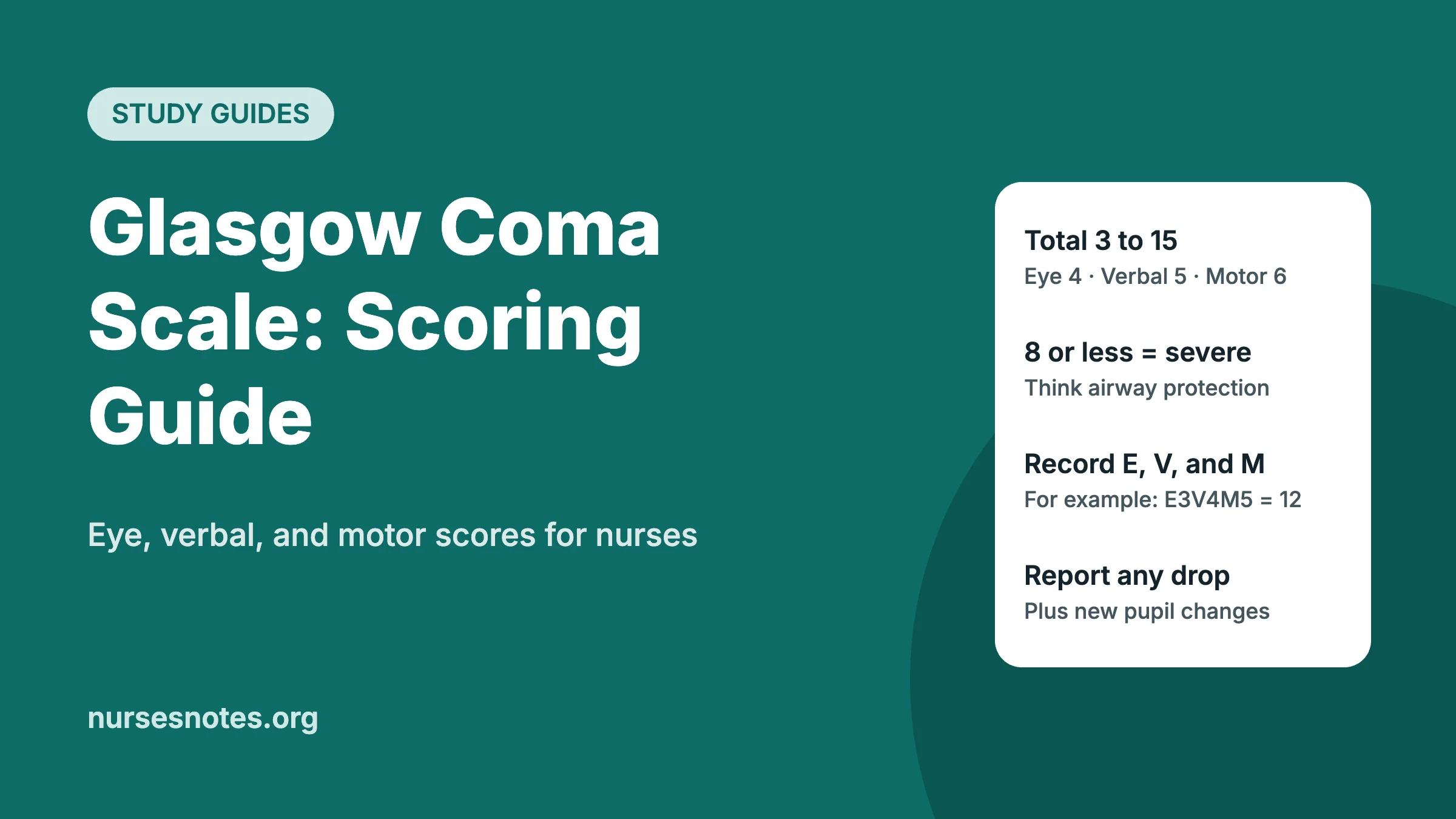
- The GCS adds eye (1 to 4), verbal (1 to 5), and motor (1 to 6) scores for a total of 3 to 15.
- In head injury, 13 to 15 is mild, 9 to 12 is moderate, and 3 to 8 is severe.
- Always report each component (for example, E3V4M5) as well as the total out of 15.
- A falling score, new pupil changes, or new weakness needs urgent escalation.
What is the Glasgow Coma Scale?
The GCS was first described in 1974 by Graham Teasdale and Bryan Jennett in Glasgow, Scotland. It gives nurses and doctors a shared, structured way to describe how awake and responsive a patient is.
You will use it for head injury, stroke, seizures, overdose, sepsis with confusion, and any patient whose level of consciousness may change. Its real strength is in trends: one score is a snapshot, but serial scores show whether the patient is improving or getting worse.
GCS scoring table
Each component is scored on the best response you observe. The table shows the descriptors used in StatPearls, with the current wording from the official GCS website (Royal College of Physicians and Surgeons of Glasgow) in brackets where it differs.
| Score | Eye opening (E) | Verbal response (V) | Motor response (M) |
|---|---|---|---|
| 6 | – | – | Obeys commands |
| 5 | – | Oriented | Localizes pain (localising) |
| 4 | Opens spontaneously | Confused | Withdraws from pain (normal flexion) |
| 3 | Opens to command (to sound) | Inappropriate words (words) | Abnormal flexion |
| 2 | Opens to pain (to pressure) | Incomprehensible sounds (sounds) | Abnormal extension (extension) |
| 1 | No eye opening | No verbal response | No motor response |
The lowest possible score is 3, not 0, because every component starts at 1. A fully alert, oriented patient who obeys commands scores E4V5M6 = 15.
GCS score interpretation
For traumatic brain injury, StatPearls groups total scores into three severity bands. These bands are a guide only and must be read alongside the full clinical picture.
| Total GCS | Severity | What it usually means for care |
|---|---|---|
| 13 to 15 | Mild | Close observation; imaging and discharge decisions follow local head injury guidance |
| 9 to 12 | Moderate | Closer monitoring and medical review, as guided by local policy |
| 3 to 8 | Severe | Emergency management, including protecting the airway |
Remember that two patients with the same total can be very different. StatPearls notes that the motor score is the most informative part of the scale in severe impairment, which is why the components matter more than the sum.
How to assess GCS: step by step
The official GCS website recommends a structured approach called Check, Observe, Stimulate, Rate.
- Check for factors that interfere with the assessment, such as hearing loss, a language barrier, a breathing tube, sedation, or an injury to the face or limbs.
- Observe what the patient does spontaneously before you touch or speak to them.
- Stimulate with sound first (speak, then call loudly), and use a physical stimulus only if there is no response.
- Rate the best response for each component against the defined criteria.
For physical stimulation, the GCS assessment aid describes fingertip (nail bed) pressure as the peripheral stimulus, and trapezius or supraorbital notch pressure as central stimuli. It strongly discourages sternal rubbing because it can bruise and makes responses harder to interpret.
Nursing assessment: what to record
NICE head injury guidance says neurological observations should include more than the GCS alone. A complete set includes:
- GCS, with each component written out (E, V, and M) and the total given out of 15
- Pupil size and reaction to light
- Limb movements and any difference between left and right
- Respiratory rate, heart rate, blood pressure, temperature, and oxygen saturation
If a component cannot be tested, record it as NT (not testable) with the reason, and do not report a total. For intubated patients the verbal score cannot be assessed; StatPearls describes noting this with a suffix such as “ET,” but follow your facility’s charting rules.
Some units also use the GCS-Pupils score (GCS-P). It subtracts a pupil reactivity score (0 if both pupils react, 1 if one does not, and 2 if neither reacts) from the GCS total, giving a range of 1 to 15.
Nursing interventions and when to escalate
For an admitted patient with a GCS of 15 after head injury, NICE recommends observations at least every 30 minutes for 2 hours, then hourly for 4 hours, then every 2 hours. If the patient deteriorates, go back to half-hourly checks and restart the schedule.
Escalate urgently to the doctor if you see any of these signs NICE lists:
- Agitation or abnormal behaviour
- A drop of 1 point in GCS that lasts at least 30 minutes (give more weight to a drop in the motor score)
- A drop of 3 or more points in eye or verbal scores, or 2 or more points in the motor score
- Severe or worsening headache, or persistent vomiting
- New or evolving signs such as unequal pupils or weakness on one side of the face or body
While you wait for review, keep the airway clear, position the patient safely, monitor oxygen saturation, and have suction ready. Ask a second competent colleague to confirm the change if possible, but do not delay escalation.
Limitations of the GCS
The scale can be misleading when other factors affect responses. StatPearls lists intoxication, sedation, low oxygen levels, low blood pressure, hypothermia, seizures, language barriers, and injuries to the face, eyes, or spinal cord.
The GCS also does not test brainstem reflexes, pupils, or breathing, so it never replaces a full neurological assessment. Young children need a modified paediatric version, and StatPearls notes that a different cut-off may better identify severe head injury in children.
If your patient also has fluid or electrolyte problems, such as low sodium, confusion may have a metabolic cause. Our guide to sodium, potassium, calcium, and magnesium explains how electrolyte changes affect the brain.
Exam tips
- Remember 4, 5, 6: Eyes have 4 points, Verbal has 5, and Motor has 6. Think “4, 5, 6” in the order E, V, and M.
- Lowest score is 3: Exam distractors often offer 0 as the minimum. It is always 3.
- “Less than 8, think airway”: A GCS of 8 or less is severe and calls for urgent airway protection.
- Flexion trap: Withdrawal (normal flexion) scores 4; abnormal flexion (decorticate posture) scores 3; extension (decerebrate posture) scores 2.
- Same total, different patient: E2V2M5 and E3V3M3 both equal 9, but they describe very different patients. If a question asks what to report, choose the answer that gives the components.
Frequently asked questions
What is a normal Glasgow Coma Scale score?
A normal score is 15: the patient opens their eyes spontaneously, is fully oriented, and obeys commands. Some healthy people may score slightly lower because of hearing loss, language barriers, or dementia, which is why nurses compare each result with the patient’s own baseline and record all three components separately.
What does a GCS of 8 mean?
A score of 8 or less falls in the severe range. It suggests the patient may not be able to protect their own airway, so it usually prompts emergency management such as airway support and urgent medical and neurosurgical review. Always look at the individual components and trends, not the total alone.
How often should a nurse check GCS?
It depends on the patient and your facility’s policy. For adults admitted after a head injury with a GCS of 15, NICE recommends checks every 30 minutes for 2 hours, hourly for 4 hours, and then every 2 hours, returning to half-hourly checks if the patient deteriorates.
Related on Nurses Notes
- 5 moments for hand hygiene: nursing study guide
- ABG interpretation steps: a simple guide for nurses
- Electrolytes made simple: sodium, potassium, calcium, and magnesium
- Types of insulin chart: onset, peak, and duration
- All Study Guides on Nurses Notes
Sources
- Glasgow Coma Scale – StatPearls, NCBI Bookshelf (Munakomi S, Margetis K, Iverson LM), updated June 2026
- Glasgow Coma Scale – Royal College of Physicians and Surgeons of Glasgow, accessed October 2026
- GCS Aid – Royal College of Physicians and Surgeons of Glasgow, accessed October 2026
- Head injury: assessment and early management (NG232) – National Institute for Health and Care Excellence (NICE), 2023
This article is for education only and does not replace advice from your own doctor, nurse, or other qualified health professional. Always follow your facility’s policies and reference ranges.