On this page
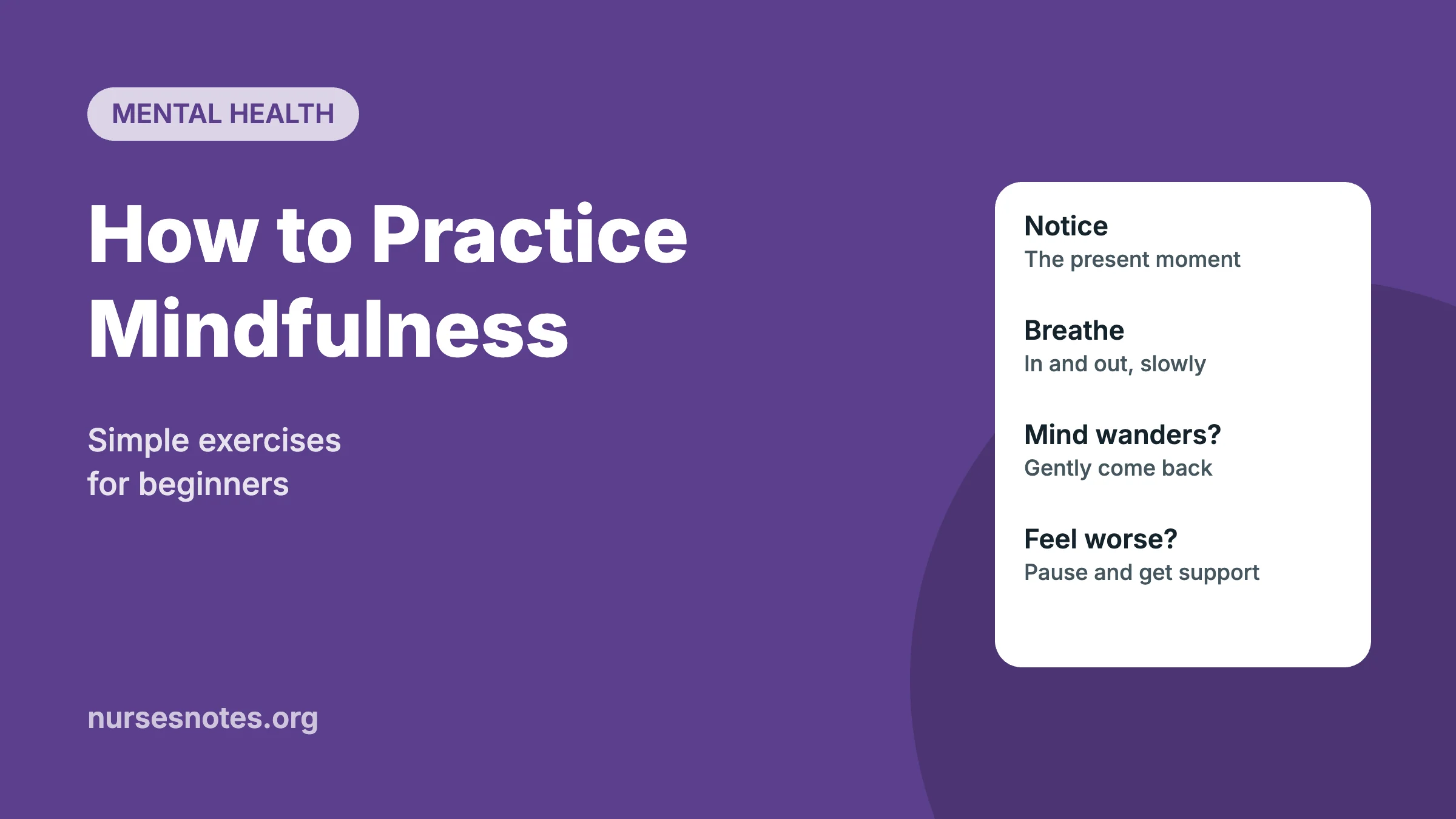
To practice mindfulness, you gently bring your attention to what is happening right now, such as your breath, your body, or the sounds around you, and notice your thoughts and feelings without judging them. You can start with a few minutes a day, using ordinary moments like a walk, a meal, or the start of a shift.
Key points
- Mindfulness means paying attention to the present moment, inside and outside yourself, with curiosity rather than judgment.
- Your mind will wander, and noticing that and coming back is the practice itself.
- Studies suggest mindfulness can help with stress, anxiety, and depression, but it does not suit everyone and is not a replacement for treatment.
- If you feel worse when practising, stop and talk to a health professional.
What is mindfulness?
The NHS describes mindfulness as paying attention to what is going on inside and outside ourselves, moment by moment. The U.S. National Center for Complementary and Integrative Health (NCCIH) defines it as keeping your awareness on the present moment without making judgments.
How to practice mindfulness in daily life
You do not need special equipment or a lot of time. These everyday ideas are adapted from NHS advice:
- Notice the everyday. Pay attention to the taste and texture of your food, the feel of water on your hands, or the air on your skin as you walk.
- Pick a regular time. Choose a daily moment, such as your commute, a coffee break, or handover, to notice what is around you.
- Try something new. Sit somewhere different or take a new route; small changes help you see things afresh.
- Watch your thoughts. Let them come and go like traffic passing, without following each one.
- Name what you feel. Silently label it, for example, “This is worry” or “This is tiredness.”
A simple mindfulness exercise for beginners
This short breathing practice is based on the NHS Every Mind Matters guide to meditation for beginners:
- Get comfortable. Sit in a quiet place with your back supported and your feet on the floor.
- Close your eyes or lower your gaze, and notice how the seat and floor feel beneath you.
- Notice your senses. What can you hear, smell, or feel right now?
- Follow your breath. As you breathe in, silently say “breathe in”; as you breathe out, say “breathe out.”
- When your mind wanders, gently return. Noticing that you drifted is a success, not a failure. If it wanders ten times, come back ten times.
- Finish slowly. Stop the words, sit quietly for a minute or two, and then open your eyes.
The NHS suggests about 20 minutes as a guide, but if that feels like too much, starting with a few minutes and building up is fine. If you prefer a counting rhythm, try our box breathing technique, or use the 5-4-3-2-1 grounding technique when you feel overwhelmed.
Mindfulness tips for nurses and shift workers
- Take one mindful breath before entering a patient’s room or answering a call bell.
- Use hand hygiene moments as a cue to notice your breath and the feel of the water or gel.
- On a break, eat one part of your meal slowly and without your phone.
- After a hard shift, notice and name your feelings before you head home.
Mindfulness can support you, but it cannot fix unsafe staffing or heavy workloads. If you feel exhausted, detached, or dread going to work, read our guide to the signs of nurse burnout and talk to someone you trust.
Does mindfulness work?
The NHS says studies show mindfulness can help with stress, anxiety, and depression, and that NICE recommends mindfulness-based therapies as one option for less severe depression. NCCIH reports that some reviews found benefits for anxiety, depression, and sleep quality, but it also says much of the research is preliminary and not always rigorous.
Is mindfulness safe for everyone?
For most people, mindfulness has few risks, but it is not right for everyone. The NHS notes that some people find it does not help or makes them feel worse, and an NCCIH-cited review found that about 8 percent of participants had an unwanted effect, most often anxiety or low mood.
- Stop or pause if a practice brings up distressing memories or feelings.
- Do not use mindfulness to replace treatment or to delay seeing a health professional.
- If you have a mental health condition, tell your doctor or therapist before starting a course.
When to get more help
Reach out to a doctor, nurse, or mental health professional if low mood, worry, or stress lasts for more than a couple of weeks, affects your work or relationships, or makes everyday tasks hard. Support works, and asking for it is a strong step.
If you are having thoughts of ending your life or feel you cannot keep yourself safe, contact a crisis line or your local emergency number now.
Where to get help
If you are struggling, you do not have to cope alone. Help is available now:
- Philippines: NCMH Crisis Hotline, call 1553 (Luzon-wide landline, toll-free), Globe/TM 0917-899-8727 or 0966-351-4518, Smart/Sun/TNT 0908-639-2672, available 24/7
- USA: 988 Suicide & Crisis Lifeline, call or text 988, or chat at 988lifeline.org, 24/7
- UK: Samaritans, call 116 123 for free, 24/7
- Anywhere: if you or someone else is in immediate danger, call your local emergency number
Frequently asked questions
How long should I practice mindfulness each day?
There is no fixed rule. The NHS Every Mind Matters guide suggests about 20 minutes as a helpful target for a sitting practice, but a few minutes of mindful breathing is a good place to start. Many people find that practising at the same time each day helps the habit stick.
What is the difference between mindfulness and meditation?
Meditation is a broad term for practices that train attention, such as focusing on the breath, a sound, an image, or a word. Mindfulness is one approach: noticing the present moment without judgment. You can practise it in formal meditation or during everyday activities like walking, eating, or washing your hands.
Can mindfulness help with anxiety?
Mindfulness may help some people manage anxiety, and the NHS says studies support its use for stress, anxiety, and depression. However, results vary, and it can make some people feel worse. If anxiety is affecting your daily life, talk to a health professional about the full range of treatments available.
Related on Nurses Notes
- Box breathing technique: how to do it
- 5-4-3-2-1 grounding technique for anxiety
- How to stop overthinking: practical steps
- Signs of nurse burnout
- More mental health articles
Sources
- Mindfulness. NHS, reviewed 17 August 2026.
- How to meditate for beginners. NHS Every Mind Matters, 2023.
- Meditation and Mindfulness: Effectiveness and Safety. National Center for Complementary and Integrative Health (NIH), June 2022.
- Lusog-Isip. Department of Education, Philippines (accessed 14 November 2026).
- 988 Suicide & Crisis Lifeline (accessed 14 November 2026) and Samaritans (accessed 14 November 2026).
This article is for education only and does not replace advice from your own doctor, nurse, or other qualified health professional.