On this page
To stop overthinking, it helps to notice when your mind is stuck in a loop, then gently move it on with a practical step, such as writing worries down, setting a short daily “worry time”, or turning a worry into a plan. Overthinking is a habit, not a personal failing, and with practice most people can loosen its grip.
Key points
- Overthinking means replaying the past or worrying about the future without reaching a solution.
- Simple tools such as worry time, writing things down, and refocusing on the present help many people.
- Sleep, movement, and talking to someone you trust make overthinking easier to manage.
- If worry is hard to control or affects work, sleep, or relationships, talking therapies such as CBT can help.
What is overthinking?
Overthinking is when the same thoughts go round and round, like a broken record. It often takes two forms: rumination, which dwells on the past (“Why did I say that?”), and worry, which jumps to the future (“What if it goes wrong?”).
The key difference from problem-solving is that overthinking does not lead anywhere. Problem-solving asks “What can I do now?” and ends in a decision, while rumination keeps asking “Why?” without an answer.
Signs you may be overthinking
- Replaying conversations, mistakes, or a hard shift long after it ended
- Struggling to make decisions because you keep weighing every option
- Lying awake at night with a busy mind
- Feeling restless, irritable, or tired, or finding it hard to concentrate
- Tension in the neck and shoulders, or an upset stomach when stressed
Overthinking can be part of stress, anxiety, or low mood. It can also make these feel worse, which is why it is worth tackling early.
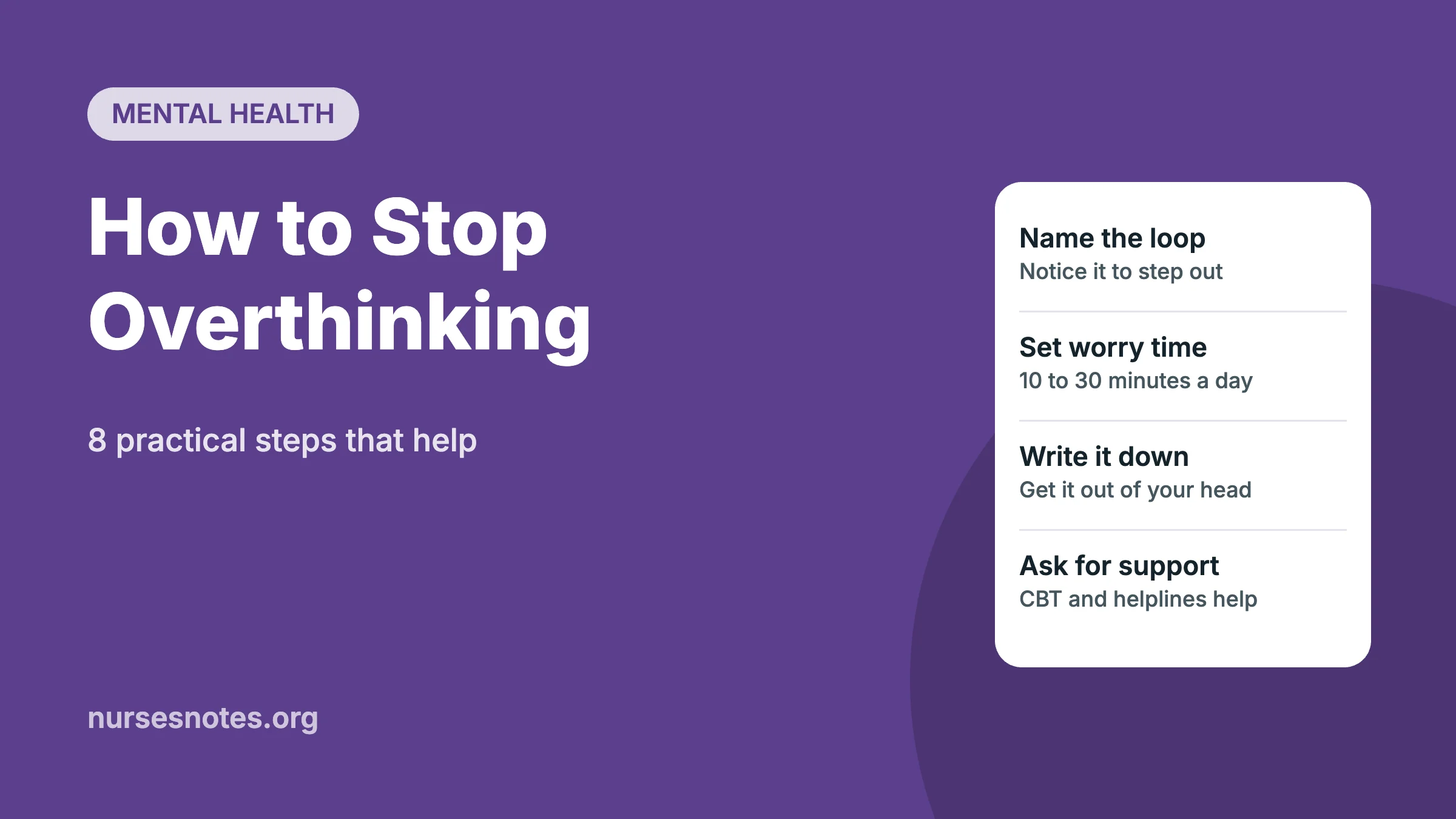
How to stop overthinking: 8 practical steps
- 1. Name it. When you notice the loop, say to yourself, “I’m overthinking again.” Simply noticing it gives you a moment to choose what to do next.
- 2. Schedule worry time. Set aside a short, fixed time each day (for example, 10 to 30 minutes) to think about your worries. If one pops up at another time, jot it down and save it for later.
- 3. Write it down. Putting thoughts on paper gets them out of your head. Some people like to close the notebook or put the page away afterwards as a sign that they are done for now.
- 4. Sort what you can and cannot control. For worries you can act on, pick one small next step. For those you cannot change, practise letting them be.
- 5. Turn “what if” into “if, then”. Instead of “What if I fail the exam?”, try “If I fail, then I will talk to my lecturer and plan a resit.” A plan calms the mind more than endless what-ifs.
- 6. Question the thought. Ask yourself what the evidence is, whether there is another way to see it, and what you would tell a friend in the same situation.
- 7. Come back to the present. Mindfulness, slow breathing, or grounding can calm a racing mind. Try our box breathing technique or the 5-4-3-2-1 grounding technique.
- 8. Change gears. Go for a walk, do something creative, or call a friend. Healthy distraction breaks the loop and lifts your mood.
Look after the basics
A tired, hungry, or overloaded mind overthinks more. Mind (UK) suggests getting enough sleep, eating regularly, staying physically active, and spending time in nature. Our sleep hygiene tips can help if worries keep you up at night.
Be kind to yourself, too. Telling yourself off for overthinking only adds another loop. Treat yourself the way you would treat a worried friend.
Overthinking after a shift: a note for nurses
Many nurses go home replaying a difficult patient, a near miss, or a conversation with a family. Try a short “end of shift” routine: note one thing that went well, one thing to follow up, and then let the rest go until your next shift. If an event keeps bothering you, talk it through with a trusted colleague, your manager, or your staff support or employee assistance service.
When to get help
Speak to a doctor, nurse, or mental health professional if worry feels hard to control, lasts for weeks, or affects your sleep, work, studies, or relationships. Talking therapies such as cognitive behavioural therapy (CBT) are effective, and some people also benefit from medicine if anxiety or depression is driving the cycle. Asking for help is a sign of strength, and things can get better.
Where to get help
If you are struggling, you do not have to cope alone. Talk to someone you trust, or contact a free helpline:
- Philippines: NCMH Crisis Hotline, 24/7: call 1553 or 0917 899 8727.
- USA: 988 Suicide & Crisis Lifeline, 24/7: call or text 988, or chat at 988lifeline.org.
- UK: Samaritans, free, 24 hours a day: call 116 123.
- Anywhere: if you or someone else is in immediate danger, call your local emergency number or go to the nearest emergency department.
Frequently asked questions
Is overthinking a mental illness?
No, overthinking on its own is not a mental illness. It is a common habit that almost everyone experiences at times, especially under stress. However, constant overthinking can be linked with anxiety, depression, or other conditions, so if it is hard to control or affects daily life, it is worth speaking to a health professional.
How do I stop overthinking at night?
Try a “worry time” earlier in the evening so worries are not saved for bedtime, and keep a notebook by the bed to jot down thoughts. Slow breathing or grounding can help you settle. If you cannot sleep after a while, get up, do something calm in dim light, and return to bed when sleepy.
What is the difference between overthinking and problem-solving?
Problem-solving looks for practical steps and ends with a decision or action. Overthinking circles around the same questions, such as “Why did this happen?” or “What if?”, without finding answers. A quick test is to ask yourself whether your thinking is leading to a next step. If not, it is time to change gears.
Related on Nurses Notes
- How to manage stress: practical tips
- Box breathing technique for stress and anxiety
- Sleep hygiene tips for better rest
- More mental health articles
Sources
- How To Stop Overthinking: Tips and Coping Strategies — Cleveland Clinic, 2022
- How To Stop Ruminating — Cleveland Clinic, 2026
- Anxiety — NHS Every Mind Matters, 2026
- How to manage anxiety and worry — Mind (UK), 2026
- 988 Suicide & Crisis Lifeline — 988 Lifeline, accessed November 2026
- Samaritans — Samaritans, accessed November 2026
- DOH and WHO promote holistic mental health wellness in light of World Suicide Prevention Day — WHO Philippines, 2020 (NCMH hotline numbers)
This article is for education only and does not replace advice from your own doctor, nurse, or other qualified health professional.