
On this page
- Why talking to a doctor helps
- How to prepare for your appointment
- What to say to start the conversation
- What your doctor may ask or do
- What happens next
- Is what I say confidential?
- If you feel dismissed
- A note for nurses and nursing students
- When to get help urgently
- Where to get help
- Frequently asked questions
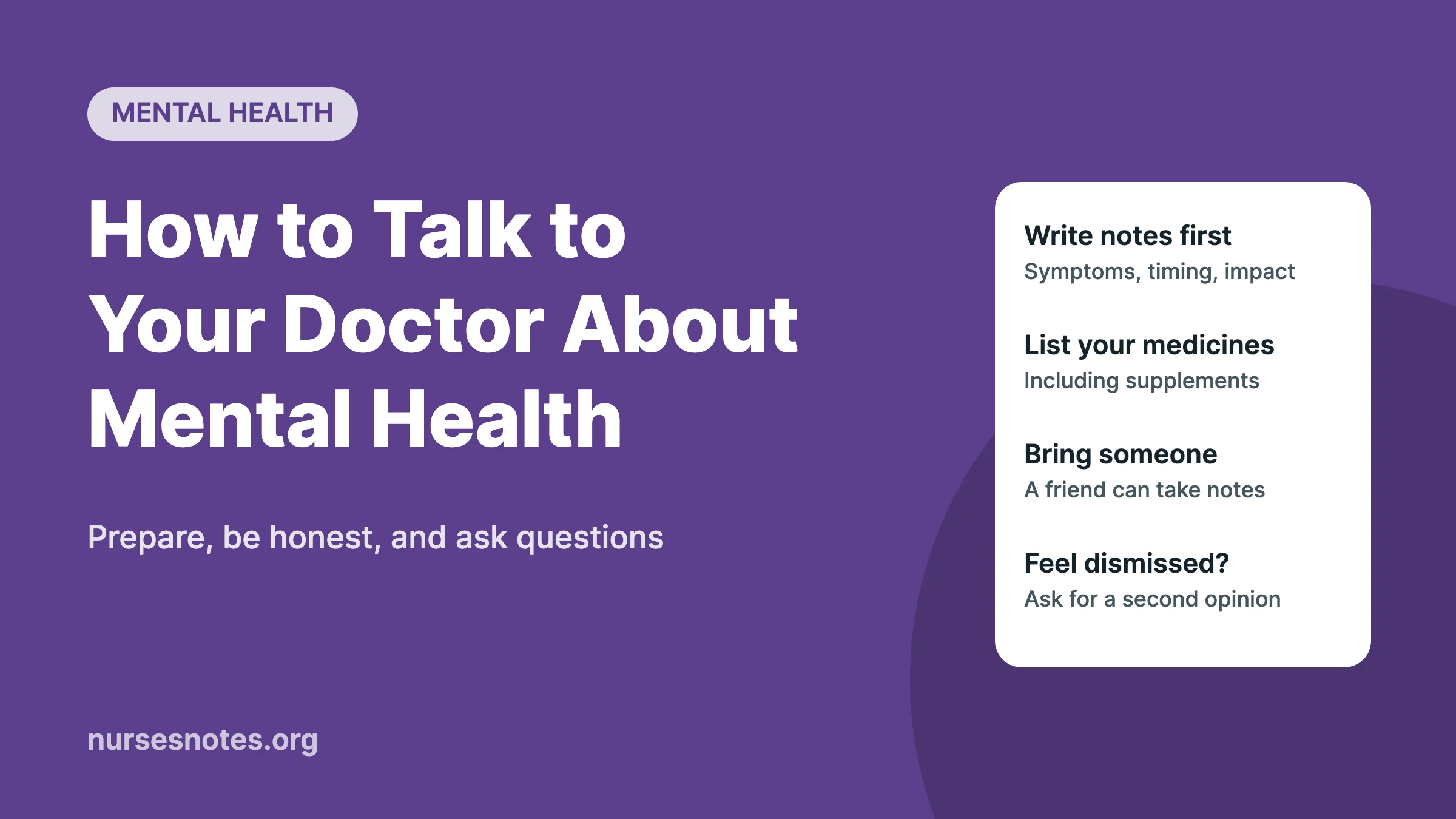
The best way to talk to your doctor about mental health is to prepare a few notes beforehand, describe honestly how you have been feeling and how it affects your daily life, and ask what your options are. You do not need the “right” words, and it is always okay to ask for help, whether you are a student, a busy nurse, or a parent juggling everything at home.
Key points
- Your family doctor or primary care provider is a good first step and can refer you to specialist care if needed.
- Write down your symptoms, when they started, how often they happen, and how they affect your sleep, work, and relationships.
- Bring a list of all medicines and supplements, and consider bringing someone you trust.
- If you feel dismissed, you can ask for a second opinion or see a different provider.
Why talking to a doctor helps
Many people wait months before mentioning low mood, worry, or poor sleep, often because they feel embarrassed or think their problems are “not serious enough.” The National Institute of Mental Health (NIMH) notes that you can raise mental health concerns at any visit with your primary care provider.
Your doctor can check for physical causes, talk through what you are experiencing, and help you find support such as talking therapy, medicine, or referral to a specialist. Getting help early often makes recovery easier.
How to prepare for your appointment
- Write down what you have noticed. Note your main feelings or symptoms, when they started, how severe they are, and how often they happen.
- Describe the impact. Think about how your sleep, appetite, energy, concentration, work, and relationships have changed.
- List recent stresses. Include events such as a loss, a move, money worries, exams, or heavy workloads and night shifts.
- List your medicines. Include prescription and over-the-counter medicines, herbal remedies, vitamins, and supplements.
- Consider bringing someone. A trusted friend or relative can support you and take notes, or you can see the doctor alone first.
- Think about family history. If relatives have had mental health conditions, mention it.
- Prepare your questions. Write down two or three things you most want to ask.
- Ask for more time if you need it. Mind suggests asking for a longer or double appointment when booking, as standard visits can be short.
What to say to start the conversation
Mind reminds us that there is no wrong way to tell someone how you feel. If it is hard to begin, try one of these openers:
- “I have not been feeling like myself for a few weeks, and I would like to talk about my mental health.”
- “I am struggling with stress and sleep, and it is affecting my work.”
- “I have written some notes because this is hard to say. Could you read them?”
Be as honest as you can, even about things that feel embarrassing. Your doctor has heard similar concerns many times and needs the full picture to help you. If you cope with stress in ways you are worried about, it is safe and important to say so.
What your doctor may ask or do
- Ask about your mood, sleep, appetite, energy, and daily activities
- Ask about life events, alcohol or substance use, and family history
- Use a short questionnaire to understand your symptoms
- Do a physical check or blood tests to rule out other causes
- Ask whether you have had thoughts of harming yourself, which is a routine and caring question
What happens next
Depending on your needs, your doctor may suggest a follow-up visit to see how you are doing, talking therapy such as cognitive behavioral therapy, medicine, lifestyle changes, or referral to a psychiatrist or psychologist. You can ask about the benefits and side effects of each option and decide together.
If you start treatment, do not stop a medicine without talking to your doctor first. It can take time to find what works, and that is normal.
Is what I say confidential?
In most cases, yes: NIMH says your discussions cannot be shared without your permission. Mind explains that a doctor may need to share information if someone is in immediate danger of serious harm, and should usually tell you first. Rules differ between countries, so you can ask your doctor how confidentiality works where you live.
If you feel dismissed
Not every appointment goes well. NIMH notes that you may need to see more than one provider to find the right fit, and treatment works best when you have a good relationship with your provider.
You can ask for a follow-up or referral, book with a different doctor, or use other routes such as a university health service, occupational health, or an employee assistance program.
A note for nurses and nursing students
Nurses are often better at caring for others than asking for help themselves. If stress, burnout, or exam pressure is wearing you down, seeing your own doctor is a professional strength, not a weakness.
When to get help urgently
Go to the nearest emergency department or call your local emergency number if you or someone else is in immediate danger. If you are having thoughts of suicide or feel unable to keep yourself safe, reach out to a crisis line now rather than waiting for an appointment.
Where to get help
If you are in crisis or worried about your safety, please reach out now. You do not have to face this alone.
- USA: call or text 988, or chat at 988lifeline.org (988 Suicide & Crisis Lifeline: free, confidential, and available 24/7)
- UK and Ireland: call Samaritans free on 116 123, 24 hours a day, 365 days a year (samaritans.org)
- Anywhere: call your local emergency number or go to the nearest emergency department
- Talk to someone you trust, such as a friend, family member, or your own doctor or nurse
Frequently asked questions
Can I talk to my regular doctor about mental health?
Yes. A family doctor or primary care provider can assess your symptoms, check for physical causes, start treatment, and refer you to a psychiatrist, psychologist, or counselor if needed. You can raise mental health at any appointment, even one booked for something else, though asking for a longer slot gives you more time to talk.
What should I say to my doctor about anxiety or depression?
Describe what you feel, how long it has been happening, how often it occurs, and how it affects your sleep, work, and relationships. Mention any recent stresses and all medicines you take. If speaking feels hard, bring written notes and ask the doctor to read them. There is no wrong way to say it.
Will my doctor think I am overreacting?
Doctors see people with stress, anxiety, and low mood every day, and it is always okay to ask for help. Early support often works better than waiting until things feel unmanageable. If you ever feel brushed off, you can ask for a follow-up, see another provider, or seek a second opinion.
Related on Nurses Notes
- Signs of depression and when to get help
- Signs of anxiety: symptoms and support
- What is cognitive behavioral therapy?
- All mental health articles
Sources
- Tips for Talking With a Health Care Provider About Your Mental Health, National Institute of Mental Health
- Help for Mental Illnesses, National Institute of Mental Health, reviewed April 2026
- How to get help from your GP for mental health, Mind, November 2025
- 988 Suicide & Crisis Lifeline, 988 Lifeline (accessed November 2026)
- Contact Us, Samaritans (accessed November 2026)
This article is for education only and does not replace advice from your own doctor, nurse, or other qualified health professional.