On this page
What is cognitive behavioral therapy? Cognitive behavioral therapy (CBT) is a structured, short-term talking therapy that helps you notice unhelpful thoughts and habits and change them, so you can cope better with problems like anxiety and depression. It focuses on what is happening now rather than on your past, and it teaches practical skills you can keep using after therapy ends.
Key points
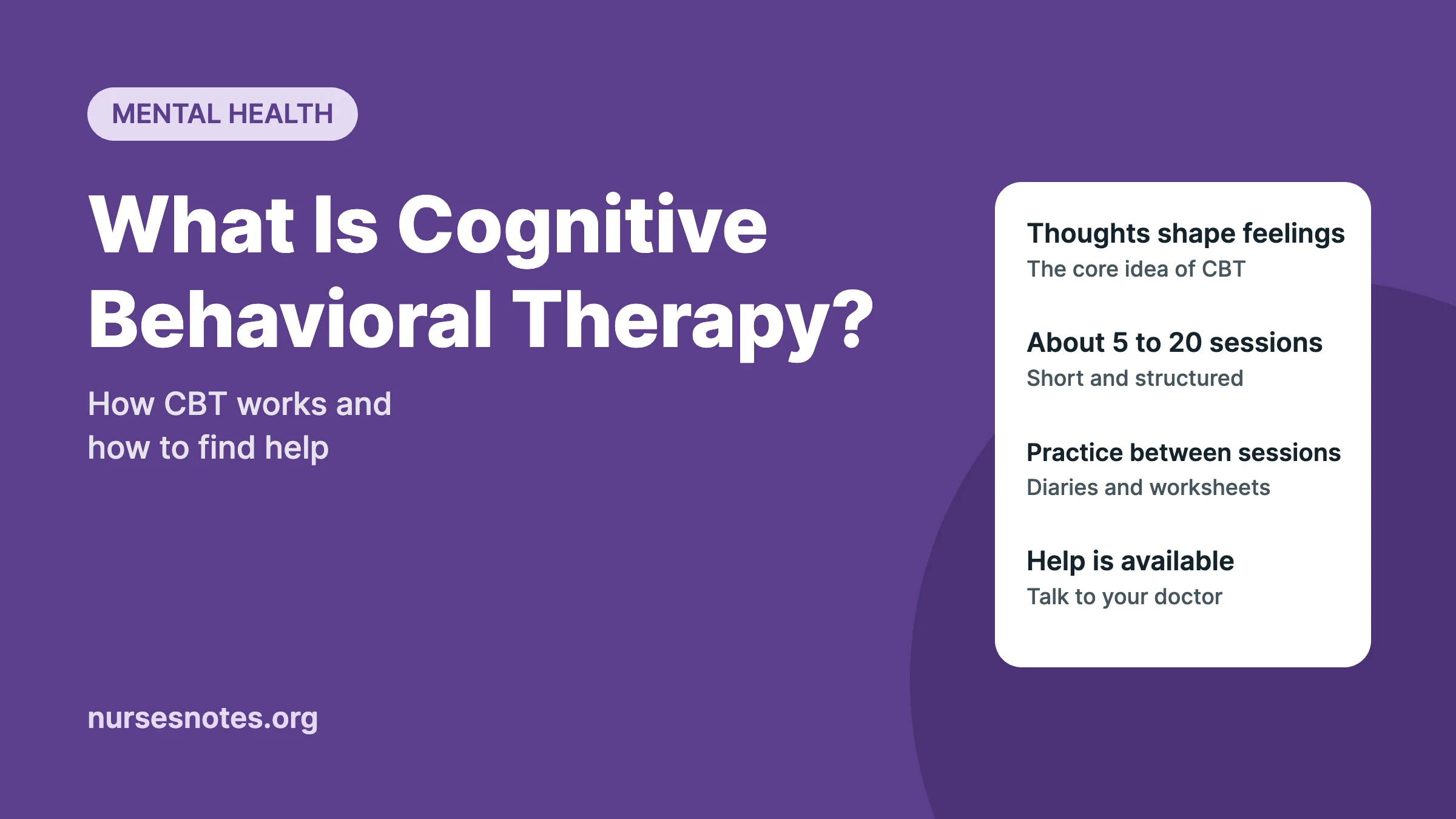
- CBT is based on the idea that thoughts, feelings, physical sensations, and actions are linked and affect each other.
- It is used for depression, anxiety, OCD, PTSD, sleep problems, and many other conditions.
- A course is usually about 5 to 20 sessions, with practice tasks between sessions (NHS; Mayo Clinic).
- CBT does not work for everyone, and it is fine to ask about other treatments.
How does CBT work?
CBT combines two approaches: cognitive therapy, which looks at how you think, and behaviour therapy, which looks at what you do (Mind). The idea is that how you interpret a situation shapes how you feel and act.
For example, a nurse who makes a small error on shift might think, “I’m useless at this job.” That thought can bring anxiety, a tight chest, and avoiding colleagues, which then seems to confirm the thought. CBT helps you spot this cycle, check whether the thought is accurate, and try a different response.
The US National Institute of Mental Health describes CBT as helping people recognise automatic ways of thinking that are inaccurate or harmful, question them, and change self-defeating patterns.
What conditions can CBT help?
- Depression and anxiety, including social anxiety, phobias, and panic
- Obsessive-compulsive disorder (OCD) and post-traumatic stress disorder (PTSD)
- Sleep problems such as insomnia
- Eating disorders and bipolar disorder, usually alongside other treatment
- Long-term pain, irritable bowel syndrome, and chronic fatigue (NHS)
- Stress, anger, and alcohol or drug problems (Mind; NHS)
CBT may be offered on its own or alongside other treatments, including medicine. Your doctor or mental health professional can help you decide what fits you best.
What happens in CBT sessions?
You meet a trained therapist, usually weekly, in person, by phone, or online. NHS guidance says most people have between 5 and 15 sessions, while Mayo Clinic gives a range of about 5 to 20. A typical course looks like this:
- Name the problem. You and your therapist agree on what you want to work on and set goals.
- Notice your thoughts. You learn to spot the thoughts, beliefs, and feelings linked to the problem, often by keeping a diary.
- Challenge unhelpful thinking. You test whether a thought is accurate and look for more balanced ways of seeing things.
- Change behaviour. You gradually try things you have been avoiding, or new ways of coping.
- Practise between sessions. Worksheets or small tasks help the skills stick; the NHS describes this practice as important for CBT to work.
Benefits and limitations of CBT
| Benefits | Limitations |
|---|---|
| Structured and time-limited | Needs regular effort and practice between sessions |
| Teaches skills you can keep using | Facing difficult feelings can be uncomfortable at first |
| Can be done in person, by phone, or online | Does not work for everyone (Mayo Clinic) |
| Works alongside medicine when needed | Waiting lists for free services can be long (Mind) |
Can I try CBT on my own?
Guided self-help, using a workbook or an online course with support from a therapist, is one way CBT is offered (NHS). Mind notes that online CBT programmes and self-help books can also help, and NIMH lists web-based programs and apps among digital options.
Simple CBT-style skills, like those in our guide on how to stop overthinking, can help with everyday stress. They are not a replacement for professional care if your symptoms are severe or lasting.
How to find a CBT therapist
- Talk to your doctor, who can refer you to a psychologist, psychiatrist, or other mental health professional.
- Ask your workplace about an employee assistance programme (Mayo Clinic).
- Check that the therapist is properly trained and licensed, and ask about their experience with your concern.
- Ask whether online or phone sessions are available if services near you are limited.
When to get help urgently
Please seek help straight away if you have thoughts of ending your life or harming yourself, feel unable to keep yourself safe, or someone you know is in this situation. Help is available, and reaching out is a sign of strength. See the contacts below.
Where to get help
If you are in crisis, thinking about harming yourself, or feel unable to keep yourself safe, please reach out now. You do not have to go through this alone.
- Philippines: NCMH Crisis Hotline, open 24/7: call 1553 or 1800-1888-1553, or 0919-057-1553, 0966-351-4518, or 0917-899-8727 (0917-899-USAP).
- USA: 988 Suicide & Crisis Lifeline: call or text 988, or chat at 988lifeline.org. Free, confidential, and available 24/7.
- UK: Samaritans: call 116 123 for free, day or night.
- Anywhere: if you or someone else is in immediate danger, call your local emergency number or go to the nearest emergency department.
Frequently asked questions
How long does CBT take to work?
A course of CBT is usually short. The NHS says most people have between 5 and 15 sessions, and Mayo Clinic gives a range of about 5 to 20. Many people notice changes over several weeks, especially when they practise skills between sessions. If you are not improving, talk to your therapist about adjusting the plan.
Is CBT better than medication for anxiety and depression?
Neither is best for everyone. CBT helps many people with anxiety and depression, and some people benefit from therapy and medicine together. The right choice depends on how severe your symptoms are, your preferences, and your health history. Discuss the options with your doctor or mental health professional before starting or stopping any medicine.
What is an example of a CBT technique?
A common technique is a thought record. You write down a situation, the automatic thought it triggered, how you felt, and the evidence for and against that thought. Then you write a more balanced thought. Over time, this helps you catch unhelpful thinking patterns sooner and respond to them more calmly.
Related on Nurses Notes
Sources
- Cognitive behavioural therapy (CBT). NHS. Reviewed 28 March 2025.
- Cognitive behavioral therapy. Mayo Clinic. 26 February 2025.
- Cognitive behavioural therapy (CBT). Mind (UK). March 2024.
- Psychotherapies. National Institute of Mental Health (NIMH). Reviewed February 2024.
- DOH: Mental health programs, crisis hotlines available this Undas. Philippine Information Agency. 28 October 2025.
- 988 Suicide & Crisis Lifeline. Accessed 15 November 2026.
- Samaritans. Accessed 15 November 2026.
This article is for education only and does not replace advice from your own doctor, nurse, or other qualified health professional.