On this page
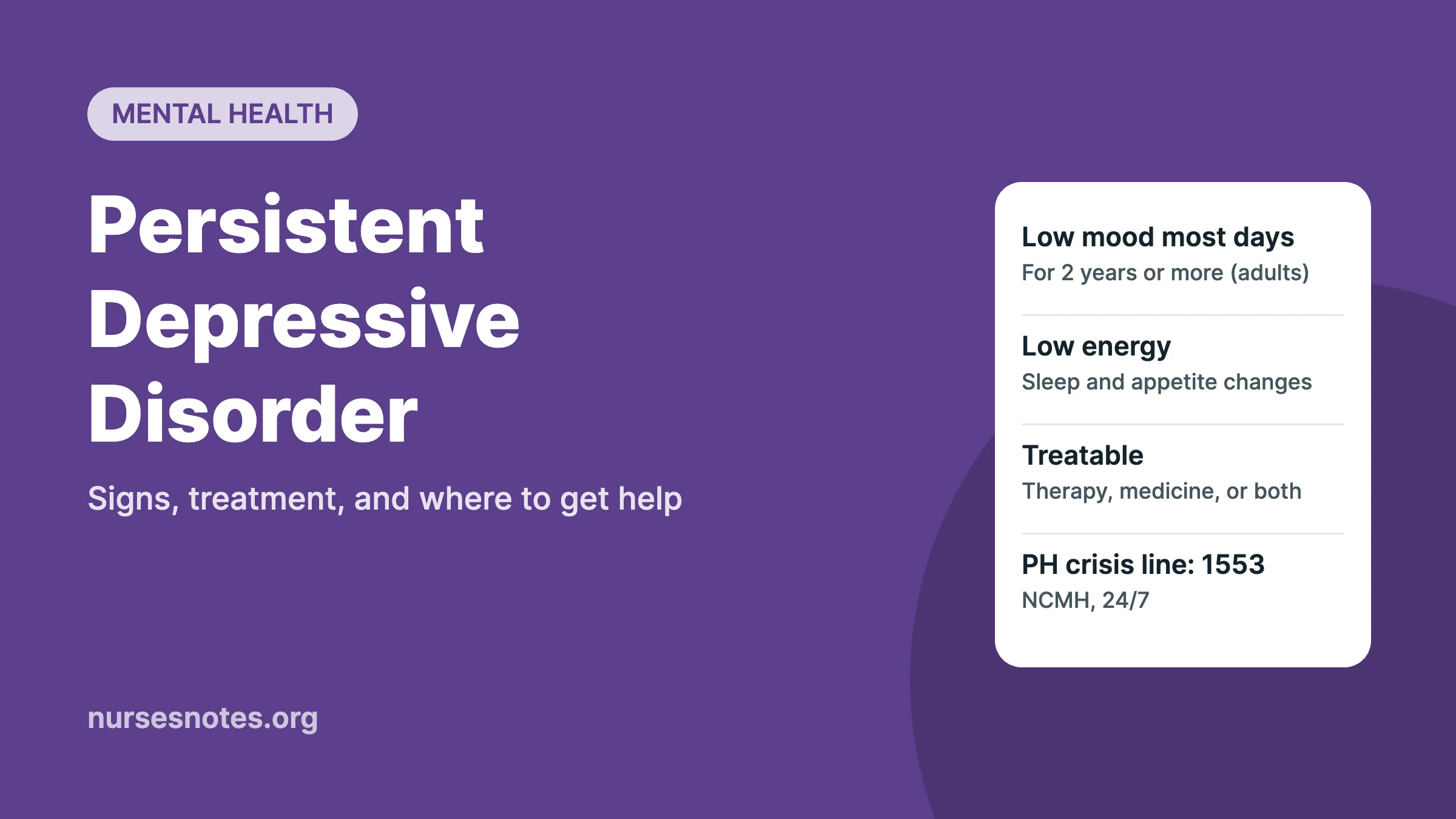
Persistent depressive disorder symptoms are a low, sad, or empty mood on most days for at least 2 years in adults (at least 1 year in children and teens, when the mood may show as irritability), together with problems such as low energy, poor sleep, or hopelessness. Because it lasts so long, many people come to think the low mood is just their personality, but persistent depressive disorder is a recognised and treatable condition.
Key points
- Persistent depressive disorder (PDD), once called dysthymia, is a long-lasting form of depression.
- Symptoms can be milder than major depression but rarely lift for more than 2 months at a time.
- Talk therapy, medicine, or a combination of both can help, and many people recover fully.
- If you ever feel unsafe or think about ending your life, contact a crisis line or emergency services now.
What is persistent depressive disorder?
Persistent depressive disorder is a chronic depression that lingers for years rather than weeks. Cleveland Clinic describes it as mild to moderate depression that does not go away, although the low mood can sometimes become more severe.
PDD often starts in childhood, the teenage years, or young adulthood. It is more common in women and tends to run in families. Many people with PDD also have at least one episode of major depression at some point, which is sometimes called “double depression”.
Common symptoms of persistent depressive disorder
Along with a low mood most of the day, on more days than not, a person with PDD usually has two or more of these:
- Feeling hopeless
- Sleeping too little or too much
- Low energy or constant tiredness
- Low self-esteem or feeling worthless
- Poor appetite or overeating
- Trouble concentrating or making decisions
Other signs people notice include losing interest in daily activities, being easily irritated or angry, avoiding friends and social plans, feeling guilty, dwelling on past worries, and struggling at work or school.
Persistent depressive disorder vs major depression
| Question | What the sources say |
|---|---|
| How long does it last? | At least 2 years in adults, or 1 year in children and teens |
| How severe is it? | Usually not as severe as major depression, but it lasts much longer |
| Does the low mood lift? | Symptoms rarely go away for more than 2 months at a time |
| Can both happen together? | Yes. Major depressive episodes can occur before or during PDD |
If you are not sure how depression in general shows up, read our guide to the signs of depression.
What causes it?
The exact cause is not known. Experts think several things play a part:
- Differences in brain chemistry and how brain areas connect
- Inherited traits, such as having a parent or sibling with depression
- Stressful life events, such as losing a loved one, money problems, or long-term stress
- Personality traits like low self-esteem, being very self-critical, or relying heavily on others
Long periods of work stress, such as heavy shifts in healthcare, can add to the load. Feeling low for years is not a weakness or a lack of effort.
How persistent depressive disorder is treated
- Talk therapy: approaches such as cognitive behavioural therapy (CBT) help you notice and change unhelpful thought patterns and build coping skills.
- Medicine: a doctor may suggest an antidepressant. These can take a month or longer to work, and should not be stopped suddenly without medical advice.
- Combined care: Mayo Clinic and Cleveland Clinic both note that therapy plus medicine often works best.
- Support groups: talking with others who understand can ease isolation.
Because PDD is long-term, treatment may also be long-term to help prevent relapse.
Self-care that helps
- Keep a steady routine for sleep, meals, and activity.
- Move your body several times a week, even short walks.
- Do one small thing you used to enjoy each day.
- Stay connected with someone you trust, and tell them how you are really feeling.
- Limit alcohol and avoid recreational drugs, which can worsen low mood.
- Know your early warning signs and make a plan with your doctor or therapist for when they appear.
When to get medical help
- You have felt low most days for weeks or longer
- Your mood is affecting work, study, relationships, or self-care
- Your symptoms are getting worse, even while on treatment
- You have thoughts of harming yourself or that life is not worth living: contact a crisis line or emergency services straight away
Not sure how to start the conversation? Our guide on how to talk to your doctor about mental health can help.
Where to get help
If you are in crisis or thinking about suicide, you are not alone, and help is available right now.
- Philippines: NCMH Crisis Hotline 1553 (toll-free landline), Globe/TM 0966-351-4518 or 0917-899-8727, Smart/Sun/TNT 0908-639-2672
- USA: 988 Suicide & Crisis Lifeline: call or text 988, or chat at 988lifeline.org
- UK and Ireland: Samaritans: call 116 123 free, any time
- Anywhere: call your local emergency number or go to the nearest emergency department
Frequently asked questions
Is persistent depressive disorder the same as dysthymia?
Yes. Persistent depressive disorder is the current name for what used to be called dysthymia. Both terms describe a depressed mood that continues for at least 2 years in adults. You may still see “dysthymia” used in older articles or by some health professionals.
Can persistent depressive disorder go away?
Yes, it can. PDD may last for years, but with treatment many people recover fully, while others find their symptoms become much milder and easier to manage. Therapy, medicine, or both, combined with steady self-care and support from people you trust, give the best chance of feeling better.
How do I know if it is PDD or just my personality?
If you have felt low, flat, or hopeless most days for 2 years or more, it may be more than your personality. Long-term depression can feel normal simply because it has lasted so long. A doctor, psychologist, or psychiatrist can assess your symptoms and talk you through treatment options.
Related on Nurses Notes
- Signs of depression: what to look out for
- What is cognitive behavioral therapy (CBT)?
- How to help someone with depression
- How to talk to your doctor about mental health
- All Mental Health articles
Sources
- Persistent depressive disorder – Symptoms and causes, Mayo Clinic, 2022
- Persistent Depressive Disorder (PDD), Cleveland Clinic, 2024
- Persistent depressive disorder, MedlinePlus Medical Encyclopedia, U.S. National Library of Medicine, reviewed 2026
- World Suicide Prevention Day, Department of Health, Cordillera Administrative Region
- 988 Key Messages, SAMHSA, 2025
- Contact a Samaritan, Samaritans
This article is for education only and does not replace advice from your own doctor, nurse, or other qualified health professional.